


Where in the World?
Following is information about each of the gemstones, minerals and crystals that I use for my jewelry pieces. You might have a favorite already, but look at the awesome variety that can be found all over our world. You might like to try something different.

Lapis Lazuli
Made from deep-blue lapis lazuli, this set epitomizes nature’s beauty. The choker adorns the neck gracefully, while the earrings add sophistication, perfect for any occasion. At Rock Isle Creations, we offer unique treasures blending elegance
and nature. Elevate your style with this exquisite set and let the stunning lapis lazuli speak for itself.
Metaphysical benefits are believed to be wisdom, self-awareness, truth and compassion.

Malachite
Malachite gemstones have been utilized for over 6,000 years. Malachite was popular with the ancient Egyptians, Greeks, and Romans for use as jewelry, amulets, and powder for eye shadow. Malachite is a light to dark green banded stone, similar but chemically different to agate. It is a copper carbonate mineral and one of the most popular on the market. Their
particular vibrant color of green is difficult to find in other natural stones. Curious note – the green that often seen on copper is actually malachite.
Metaphysical benefits are believed to be spiritual growth, protection and harmony.

Tiger's Eye
These stones display lustrous stripes which shimmer and create an optical effect that produces vertical, vibrant bands. It is predominantly found in South Africa but also in a number of locations around the world. Tiger Eye is a type of quartz, made up of silica. It is often dyed to produce a variety of stunning stones for jewelry making. Most common colors are red, blue and green.
Metaphysical benefits are believed to be self-confidence, courage and mental clarity.
Amazonite
In spite of its name, Amazonite is generally found in Egypt, the Mideast and near Pike’s Peak in Colorado! These semi-opaque, blue-green stones vary in soft hues of seafoam. Amazonite, also known as Amazon stone, is a classic case of mistaken identity. A greenish color stone was worn by Indigenous Peoples in the Amazon area of South America, and
European colonists believed these stones were locally mined. The name Amazonite took off even though no Amazonite has been found in the Amazon, and the Indigenous Peoples were likely utilizing jade. Amazonite is a type of microcline feldspar, and found in a number of locations particularly Colorado, Virginia, and China. A stunning darker, vibrant green variety is found in Russia.
Metaphysical benefits are believed to be courage, inner-harmony and emotional health.

Lava Stone
Lava rock beads are deceptively lightweight, making for easy everyday wear! Lava rock is common all over the world and has many uses outside of jewelry making. Lava rock, also known as volcanic rock or basalt, forms after volcanic eruptions
containing high levels of magnesium and iron. Magma reaches extreme heat and then cools, forming this highly porous rock. It has been estimated that volcanic rocks cover about 8% of the earth's current land surface.
Metaphysical benefits are believed to be grounding, protection, and emotional support.

Aquamarine
Aquamarine is a mineral in wonderful soft blue and blue-green colors reminding you of the ocean. They have a lovely internal texture. Some are milky and translucent whereas others are transparent. Aquamarine gets its gorgeous color from trace amounts of iron, and its name from the Latin “aqua marina”, meaning “sea water”. Brazil is the leading producer of aquamarine, but it is also mined in Pakistan, Russia, and the United States.
Metaphysical benefits: stone of courage and serenity, reputed to calm the mind and reduce stress.

Amythest
Amethyst is most plentiful in South America and Africa most often where granite rocks are exposed and therefore is a popular stone for jewelry. It is often veined producing interesting markings. The most popular is called the Chevron Amethyst. The Amethyst is in the quartz family and thought to help relieve stress.
Metaphysical benefits include Protection, Cleansing, Intuition, and relieving of stress.
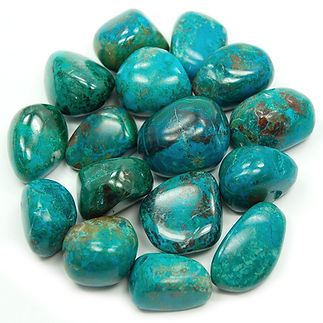
Chrysocolla
Chrysocolla is a blue green crystal with a high copper content. It is opaque in transparency with a vitreous to dull luster. Chrysocolla is a Phyllosilicate mineral often found in rounded masses, vein fillings or crusts. It is also made up of Malachite, Cuprite, Quartz, Azurite, and Limonite.
Metaphysical benefits are believed to be communication, teaching, and
transformation.

Picture Jasper
The most prominent characteristic of Picture Jasper is its intricate and often picturesque patterns. These patterns can resemble landscapes, scenes, or abstract images. They are created by the presence of various minerals and impurities that infiltrate the layers of the stone during its formation. The largest deposits of Picture Jasper are in Oregon and parts of Wales.
Metaphysical benefits are believed to be Creativity and Connection to the Earth
Krobo Beads
Krobo beads are powdered glass beads – an art form from Ghana. The origins of beadmaking in Ghana has been documented since the 1920s, but from archaeological finds, it is believed to have been an art very much earlier. Today, while now a major industry in Ghana, these exquisite, unique beads are still handmade by Ashanti and Krobo craftsmen and women. They are made by broken pieces of glass being ground into a powder, the powder is then put into molds and fired. Once fired, they are hand painted in brilliant colors. Krobo beads still play an important part of the Krobo society being used for rituals of birth, coming of age, marriage and death.
Metaphysical benefits are believed to be Femininity, Spiritual well-being and Protection.

Quartz
Quartz is a crystalline rock or mineral composed of silicon dioxide. Quartz is the second most common mineral in the Earth's continental crust and found in all types of geological environment. The color depends on the amount of Iron within the Quartz. There are approximately fifty varieties, some of the most popular being Clear, Smokey, Rose, Cherry and Strawberry Quartz.
Metaphysical benefits include Love, Trust, and Emotional Healing

Mother of Pearl
Nacre, also known as mother of pearl, is an organic–inorganic composite material produced by some mollusks as an inner shell layer. It is also the material of which pearls are composed. It is strong, resilient, and iridescent.
Metaphysical benefits are believed to be Prosperity, Purity, Youthfulness

Fancy Jasper
Fancy Jasper is a combination of chalcedony and quartz, and has been used in jewelry and decorative arts for thousands of years. It is an opaque stone with gorgeous combinations of dark green, burgundy, and purple. The name Jasper comes
from old French, jaspre, meaning “speckled stone”. Fancy Jasper Jasper can be found in Brazil and some parts of Africa.

Bamboo Coral
Very little is known about bamboo coral. The skeletons of bamboo coral are made up of calcium carbonate in the form of tree-like branches alternating with joint-like nodes composed of proteins. This gives the bamboo coral the look of fingers like the bamboo that grows on trees. The International Commission of Colored Gemstones lists Bamboo Coral as one of the five organic gemstones along with Amber, jet, and pearl.

Botswana Agate
Botswana agate is prized for its exceptional banded look. Each bead displays delicate bands of light brown, gray, and white with hints of pink, mauve, and salmon in numerous stones. Some bands are transparent, allowing a fascinating view inside the structure of the stone. Botswana Agate is one of the Quartz family minerals. These special banded agates are mined in the Southern African country of Botswana alone. The different band colors arise from trace amounts of elements such as iron and manganese.
Metaphysical benefits are believed to be grounding, balance and emotional healing.

Apatite
Apatite is a vivid, translucent, green-blue color reminding us of the color of the ocean! Apatite is named from the Greek word “apate”, meaning "deceit", since it has a similar appearance to many other gemstones. Apatite can be found in many areas of the world including India, Brazil, Mexico and South Africa. The deepest blue stones are found in Russia. Apatite is actually a group of the three phosphate minerals showing hexagonal crystals.
Metaphysical benefits are believed to be increasing your willpower and intuition.
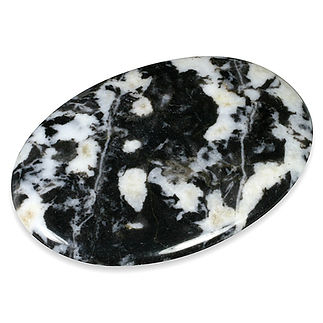
Jasper
Jasper is a combination of chalcedony and quartz, and has been used in jewelry and decorative arts for thousands of years. It is an opaque stone with gorgeous combinations of dark green, burgundy, and purple. The name Jasper comes from old French, jaspre, meaning “speckled stone”. Jasper can be found in Brazil and parts of Africa. There are numerous varieties such as Fancy Jasper, Imperial Jasper and Picture Jasper.
Metaphysical benefits are believed to be a balance of emotions and increased mental clarity.

Turquoise
Turquoise is composed of aluminum phosphate and copper. It was one of the first gemstones to be mined way back in Mesopotamia. It was first brought to Europe through Turkey which accounts for its name which is French for Turkey. Delicate veining, caused by impurities, is desired by some collectors as proof of a natural stone. It is found in Iran, southwestern United States, Africa, China, Siberia and Europe. Turquoise is actually quite rare and many stones thought to be Turquoise are in fact Turquoise Howlite.
Metaphysical benefits are believed to be truth, wisdom, healing, protection, and spiritual growth. It's considered one of the most powerful stone.
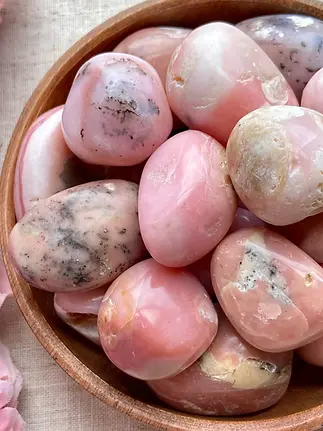
Pink Peruvian Opal
Pink Peruvian Opals have a soft, delicate look and feel to them. They are semi-transparent, and only found in the Andes Mountains near Ica, Peru. It is the official stone of Peru. Peruvian Opals are a more affordable alternative to the classic opal that has a natural play-of-color.
Metaphysical benefits are believed to be love, compassion, and emotional healing.

Snowflake Obsidian
Snowflake Obsidian is an igneous rock occurring as a natural glass formed by the rapid cooling of viscous lava from volcanoes. Obsidian is extremely rich in silica and is low in water, and has a chemical composition similar to rhyolite. Obsidian has a glassy luster and is slightly harder than window glass.
Metaphysical benefits are believed to be Grounding, Protection.

Howlite
Howlite is a calcium hydroxide that forms masses that looks something like cauliflowers. It is white with black or gray veins of other minerals in an erratic almost spiderweb-like pattern. It is porous and is often dyed. It was first found by the Canadian mineralogist Henry How. Most Howlite is found in California but also in Russia, Canada, Turkey, the Czech Republic and Mexico.
Metaphysical benefits are believed to be Letting Go, and Rest

Blue Lace Agate
Blue Lace Agate is a form of banded Chalcedony that is unique to Ysterputs, a mine in Namibia, South Africa. It is unlike other Agates in its formation. While its full formation process is still unknown, we do know it is a result of many layers of microcrystalline Quartz that build and dissolve and rebuild over time.
Metaphysical benefits are believed to be the ability to speak with conviction.
Kyanite
Kyanite is a mineral that is found in elongated, flattened blades and is usually blue in color. Its. name comes from the Greek word for “dark blue”. Within a single crystal the blue is often mixed with blue-gray The fibrous nature of kyanite makes it difficult for carvers to work.
Metaphysical benefits are known to be Psychic Abilities, Lucid Dreaming.

Jade
The term "jade" refers to two different, yet similar semi-precious metamorphic mineral gemstones, Jadeite and Nephrite. Not until the 19th century that a French mineralogist determined that jade was in fact two different materials. Nephrite is usually only green and creamy white, while jadeite can have the full range of jades colours. Jade is mined in Canada, Australia, United States and Taiwan.
Metaphysical benefits are believed to be Abundance and Wellbeing

Rhodonite/Rhodochrosite
Rhodonite and Rhodochrosite from the Greek word “rhodon” meaning rose, is a pink colored manganese silicate. Rhodochrosite, is a rose colored manganese carbonate. The two gemstones are often found in close proximity. Rhodonite is often marbled with a black matrix of manganese oxide giving it a darker look than Rhodochrosite which has a softer lighter look. Notable locations for these stones include Argentina, Peru, South Africa, and the USA. Specifically, the Sweet Home Mine in Colorado is famous for its high-quality, gem-grade rhodochrosite crystals..
Metaphysical benefits are believed to be Generosity, Nurturing and Joy
Larimar
Larimar is only found in the Dominican Republic, and was unknown to the world until 1974 when it was discovered by a Peace Corps volunteer on a beach at the foot of the Bahoruco Mountain Range. Larimar is composed mainly of pectolite which is found around the world but the pectolite found in the volcanic rocks in the Dominican Republic gives it its distinctive and unique blue coloration often called “Volcanic Blue”. Larimar's color ranges from light to deep blue, often with white streaks, resembling the Caribbean Sea. The deepest blue Larimar is rare and extremely valuable.
Metaphysical benefits are believed to be Peace, Clarity and Inner Wisdom
Sunstone
Sunstone is a warm bronze gemstone with plenty of natural sparkle. Geologically, Sunstone is a feldspar-based stone. Sunstone was named for its golden, shimmering, spangled appearance hence the name. Most Sunstone is found in Canada, Mexico, Norway, and Oregon. Newer locations have been found in South Australia.
Metaphysical benefits are believed to be leadership and generosity.
Aventurine
Aventurine is a form of quartz, distinguished by its translucent to opaque appearance and the presence of mineral inclusions that give a shimmering or glittery effect termed aventurescence. The phenomenon of aventurescence is caused by small leaf-like or plate-like inclusions, distributed throughout. Light striking the surface of these inclusions is reflected back to the viewer, creating an eye-catching sparkle. While customarily green in color, aventurine may also be found in several colors most commonly blue.
Metaphysical benefits are believed to be Strength, Confidence and Courage
Sodalite
Sodalite is a mineral used most often for carvings and some types of jewelry. Known for its rich, royal blue hues, sodalite is found in limited areas of the world. Frequently mottled with white veins of calcite, sodalite resembles lapis lazuli in appearance and has been mistaken for it at times. It can occur not only as blue, but also in crystals of gray, yellow, green or pink color.
Metaphysical benefits are believed to be Logic, Truth and Emotional Balance
Rhodonite/Rhodochrosite
Rhodonite and Rhodochrosite from the Greek word “rhodon” meaning rose, is a pink colored manganese silicate. Rhodochrosite, is a rose colored manganese carbonate. The two gemstones are often found in close proximity. Rhodonite is often marbled with a black matrix of manganese oxide giving it a darker look than Rhodochrosite which has a softer lighter look. Notable locations for these stones include Argentina, Peru, South Africa, and the USA. Specifically, the Sweet Home Mine in Colorado is famous for its high-quality, gem-grade rhodochrosite crystals..
Metaphysical benefits are believed to be Generosity, Nurturing and Joy
Rhodonite/Rhodochrosite
Rhodonite and Rhodochrosite from the Greek word “rhodon” meaning rose, is a pink colored manganese silicate. Rhodochrosite, is a rose colored manganese carbonate. The two gemstones are often found in close proximity. Rhodonite is often marbled with a black matrix of manganese oxide giving it a darker look than Rhodochrosite which has a softer lighter look. Notable locations for these stones include Argentina, Peru, South Africa, and the USA. Specifically, the Sweet Home Mine in Colorado is famous for its high-quality, gem-grade rhodochrosite crystals..
Metaphysical benefits are believed to be Generosity, Nurturing and Joy
Rhodonite/Rhodochrosite
Rhodonite and Rhodochrosite from the Greek word “rhodon” meaning rose, is a pink colored manganese silicate. Rhodochrosite, is a rose colored manganese carbonate. The two gemstones are often found in close proximity. Rhodonite is often marbled with a black matrix of manganese oxide giving it a darker look than Rhodochrosite which has a softer lighter look. Notable locations for these stones include Argentina, Peru, South Africa, and the USA. Specifically, the Sweet Home Mine in Colorado is famous for its high-quality, gem-grade rhodochrosite crystals..
Metaphysical benefits are believed to be Generosity, Nurturing and Joy
Rhodonite/Rhodochrosite
Rhodonite and Rhodochrosite from the Greek word “rhodon” meaning rose, is a pink colored manganese silicate. Rhodochrosite, is a rose colored manganese carbonate. The two gemstones are often found in close proximity. Rhodonite is often marbled with a black matrix of manganese oxide giving it a darker look than Rhodochrosite which has a softer lighter look. Notable locations for these stones include Argentina, Peru, South Africa, and the USA. Specifically, the Sweet Home Mine in Colorado is famous for its high-quality, gem-grade rhodochrosite crystals..
Metaphysical benefits are believed to be Generosity, Nurturing and Joy